


How Do Air Compressors Work
Understanding The Compression Process For Different Compressor Types
The Fundamental Principle Of Air Displacement – Understanding Positive Displacement And Dynamic Displacement…
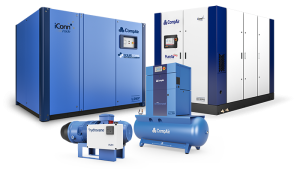
Air compression involves converting power into kinetic energy stored in pressurised or compressed air. This is done by forcing atmospheric air into a storage tank where its pressure can be increased. The science behind the compression process is simpler than people think; it all begins with one fundamental principle: air displacement. But what does this mean? Well, it refers to the working principle by which the air enters the storage tank or compression chamber. This can occur in two ways:
Positive Displacement Air Compressors: Positive displacement involves the compressor reducing the volume of its compression chamber to compress the air. This air is then transferred into a storage container for future use. Examples of this type of compressor are:
Reciprocating/Piston Compressors: Reciprocating compressors utilise a rotor, which forces a piston to move up and down. The process of the piston going down pulls air into the compression chamber, where it is compressed and forced back out when the piston rises back up. A piston or reciprocating air compressor is a very common type of positive displacement compressor.
Scroll Compressors: These systems use two spiral-shaped scrolls, one that is fixed whilst the other orbits around it. As the orbiting scroll moves, it creates a crescent-shaped air pocket that moves towards the centre, increasing in pressure as it reduces in volume, thus compressing the air.
Rotary Compressors are a common type of positive displacement air compressor and come in two main types: vane and screw.
Rotary Vane Compressors: Vane systems have an electric motor that sits off-centre in a rounded cavity. The engine has vane-operated rotors (blades) that spin to create a large air cavity. As the motor spins and air moves with it, the gap between the blades gets smaller, creating a high pressure environment which compresses the air.
Rotary Screw Compressors: Two screws are present inside this system’s motor that are moving continuously in the opposite direction, creating a vacuum that sucks the air in. The air is then trapped in a smaller space between the screw, compressing it.
Dynamic Displacement Compressors: Dynamic or non-positive displacement compressors bring air into the compression chamber using an impeller with rotating blades. The process of the blades moving creates kinetic energy, which enables a high pressure environment. The main types of dynamic compressors include:
Centrifugal Compressors: These operate by drawing air into the centre of a rotating impeller that has radial blades. Centrifugal forces then push the air out towards the perimeter of the impeller, which increases the air pressure and causes the generation of kinetic energy. Air can then be passed through a volute and a diffuser before it leads to the next compressor stage, where kinetic or potential energy is converted into pressure.
Axial Compressors: With these solutions, an axial flow means that air or gas passes along rows of stationary and rotating blades through the compressor shaft. This increases the velocity of the air, whilst the stationary blades convert the potential energy into pressure.
Oil-Free And Oil-Lubricated Air Compressors – What’s The Difference?
Different applications will require different commercial or industrial air compressors, depending on the air quality they require. Oil-lubricated compressors use oil to lubricate the compression chamber, as well as any bearings or moving parts. Oil is also used to absorb heat. However, this means that oil will need to be separated from the compressed air to avoid contamination. Oil-free compressors rely on features such as a contactless design, intercoolers, and pre-lubricated components to avoid the use of oil and thus prevent contamination as much as possible. Whilst both compressor types have their uses, for creating high-quality, Class 0 air for mission-critical applications, achieving the correct standard of air is easier with oil-free compressors.
Single-Stage vs. Two-Stage Compressors – Do They Work Differently?
Compressors are usually either single-stage or two-stage. The major difference is how much or how many times each system compresses the air. In a single-stage system, the air is compressed once, and in two-stage compressors, as the name suggests, it is compressed twice. Double compression creates a higher discharge pressure, making it better suited to certain industrial applications.
From design and installation to system maintenance and monitoring, Aircare offers the complete compressed air package with high-performance solutions to suit a wide range of industries and applications! Why not give us a call and partner with our team today? For more information on any of our solutions or to arrange an appointment, please call 01536 403808 or email us at sales@aircarecompressors.co.uk. Alternatively, you can click here to contact us, and one of our team will be happy to help and answer any questions or queries you may have!
Posted in: Articles


